
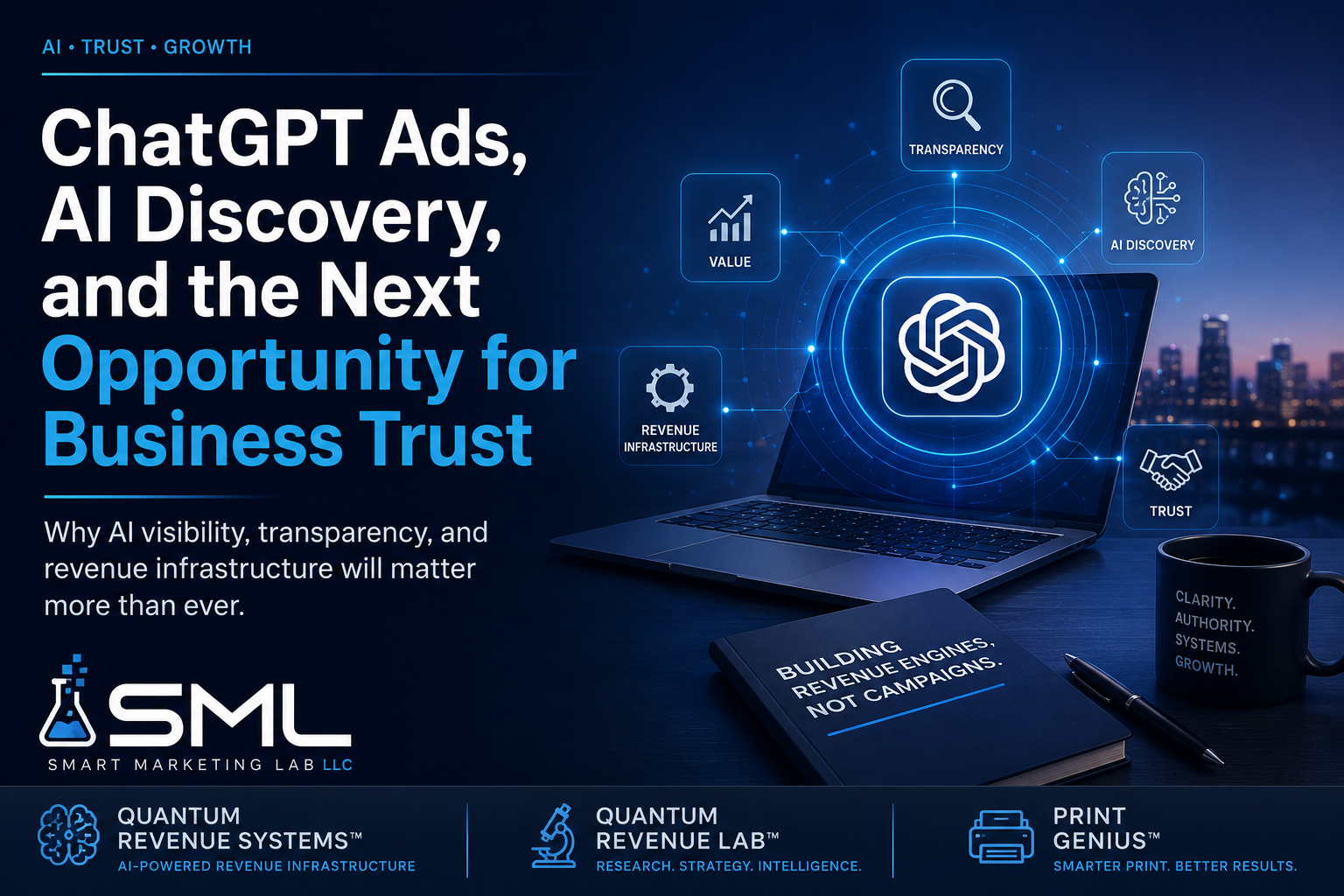
ChatGPT Ads, AI Discovery, and the Next Opportunity for Business Trust
Why AI visibility, transparency, and revenue infrastructure will matter more than ever
Artificial intelligence is moving from novelty to infrastructure.
A few years ago, most people used AI tools experimentally: writing emails, brainstorming ideas, summarizing documents, or testing prompts. Today, tools like ChatGPT and other large language models are becoming part of daily decision-making. People use them to research vendors, compare products, understand markets, prepare for meetings, write strategy documents, and make better business decisions.
That shift creates a major opportunity for businesses.
When AI becomes part of the buyer journey, visibility inside AI-powered environments becomes just as important as visibility in search engines, social platforms, review sites, and marketplaces.
Recently, there has been discussion about advertising inside ChatGPT and other AI platforms. Some people immediately see that as a risk. I see it differently.
I see it as a natural evolution of AI becoming a mainstream discovery channel.
The real question is not whether AI platforms will include advertising. Most major discovery platforms eventually develop paid visibility models. The better question is this:
How can businesses build enough trust, authority, clarity, and infrastructure to be discovered both organically and through paid channels in the AI era?
That is where the opportunity begins.
AI platforms are becoming discovery platforms
Every major technology platform goes through a predictable life cycle: first, it’s a tool; then, it’s a habit; finally, it becomes a decision layer.Search engines became decision layers. Social platforms became decision layers. Marketplaces became decision layers. Now AI assistants are becoming decision layers.
For business leaders, this matters because buyers are no longer only searching by typing keywords into Google. They are asking AI tools questions like:
“What are the best options for solving this problem?”
“What should I consider before hiring this type of company?”
“Which vendors are credible in this space?”
“What questions should I ask before buying?”
“What are the risks I should know about?”
“What companies help with this?”
That means AI tools are not only answering questions. They are shaping research, comparison, evaluation, and trust formation.
This does not replace SEO, paid advertising, LinkedIn, email, websites, or sales conversations. It adds another layer to the buyer journey.
For companies, that creates a new responsibility:
Your brand needs to be understandable to humans and machine-readable to AI systems.
That is one of the reasons we are building Smart Marketing Lab LLC and Quantum Revenue Systems™ around AI revenue infrastructure, attribution, automation, authority, and AI visibility.
Advertising inside AI is not automatically a trust problem
Advertising itself is not the problem.
Advertising can help people discover products, services, tools, and companies that are relevant to what they are trying to accomplish. When done responsibly, ads can support access, innovation, and product development.
OpenAI says that ads in ChatGPT are separate and clearly labeled, and that ads do not influence ChatGPT’s answers. OpenAI also says advertisers cannot shape, rank, or alter ChatGPT’s responses. (OpenAI Help Center)
That distinction matters.
The future of AI discovery should not be framed as “ads versus trust.” The better framing is:
Paid visibility and organic trust will both exist. The winners will be the companies that understand the difference and build for both.
In traditional search, companies learned to manage both paid search and organic SEO. In social media, companies learned to manage both paid reach and organic authority. In AI-driven discovery, companies will need to manage both paid AI placements and organic AI visibility.
But paid placement alone will not be enough. Trust will still come from substance.
The real opportunity is trust-based AI visibility
AI visibility is not just about being mentioned by an AI tool. It is about whether AI systems can clearly understand:
Who you are What you do
Who you serve What problems you solve
What proof supports your claims
How your offers are structured
What makes you different
Whether your content is credible
Whether your brand has authority signals
Whether your website and public footprint are consistent
That is why AI visibility must be treated as part of revenue infrastructure, not only as a marketing tactic.
A company can spend more on ads and still lose business if its website is unclear, its proof is weak, its positioning is inconsistent, or its funnel cannot convert informed buyers.
AI-era buyers arrive more educated. They may have already compared options, summarized alternatives, and created a shortlist before speaking with anyone. Therefore, companies need robust systems behind their visibility: attribution clarity, conversion paths, strong founder credibility, clear offers, technical confidence, and content that answers real buyer questions.
This is exactly the business problem Quantum Revenue Systems™ is being built around.
AI ads may actually raise the standard for organic authority
The presence of advertising in AI platforms may actually force businesses to become more disciplined. When buyers know paid placements exist, they become more thoughtful and search for stronger signals of credibility before making decisions. They will look for:
Evidence and case studies.
Visible founder expertise.
Presence across multiple trusted sources.
Clear business models and frameworks.
This is not bad for serious businesses; it rewards clarity, expertise, and companies that build real authority instead of renting attention.
For founders, the lesson is clear: The AI era will not eliminate the need for trust. It will make trust easier to evaluate and harder to fake.
What businesses should do now
Businesses do not need to panic about AI advertising; they need to prepare.
1. Make your positioning unmistakably clear: Both AI and human buyers need clarity. Your website should quickly answer: What do you do? Who do you help? What problem do you solve? If your positioning is vague, AI systems will struggle to classify you correctly.
2. Build founder-led authority: In the AI era, anonymous brands struggle to build trust. Make your expertise visible through LinkedIn posts, founder bios, case studies, and public frameworks.
3. Strengthen proof assets: Build a library of case studies, quantified outcomes, operational lessons, and customer quotes. AI tools evaluate relationships and relevance, and strong proof helps them understand the value you deliver.
4. Treat AI visibility as part of revenue infrastructure: Visibility without conversion is incomplete. Connect your AI efforts to SEO, CRM attribution, sales enablement, and offer architecture.
5. Separate paid from organic: A mature growth strategy includes both paid discovery (ads, retargeting) and organic trust (authority, citations, brand clarity).
At Smart Marketing Lab, we use a simple internal principle: Build revenue engines, not campaigns.
For Smart Marketing Lab, that means making my operating background, technical marketing experience, business-building experience, and revenue systems perspective more visible across Smart Marketing Lab, Quantum Revenue Systems™, and related DBA brands.
Why this is good news for serious businesses
The businesses that should be most optimistic about AI discovery are the ones willing to do the real work. AI can help surface your expertise, summarize your content, and help the right buyers understand your differentiated offer faster.
The challenge is that companies must become clearer, more structured, and more credible. That is a standard worth meeting.
What this means for SML and QRS
At Smart Marketing Lab LLC, our direction is to build AI-powered revenue systems, strategic intelligence, and vertical SaaS ventures that help businesses adapt to this new environment.
Through Quantum Revenue Systems™, the focus is on helping B2B companies identify revenue leakage, improve attribution clarity, strengthen conversion systems, evaluate AI visibility, and build revenue infrastructure that supports measurable growth.
Through Quantum Revenue Lab™, the focus is on research and strategic intelligence around AI, revenue systems, attribution, AI visibility, buyer behavior, and executive decision-making.
Through Print Genius™, the goal is to apply AI-assisted systems to a specific vertical market where quoting, workflow, CRM, and margin protection matter.
All of these ventures share one belief:
AI will not remove the need for business fundamentals. It will reward companies that organize those fundamentals better.
The founder perspective
As a founder, I view AI advertising not as the end of trust, but as a signal that AI is officially influential enough to shape how people evaluate businesses.
We cannot just ask, “How do we get more impressions?” We must also ask: “Does AI understand what we do? Are our claims supported? Can buyers trust us before they ever speak with us? Can our revenue system convert AI-informed buyers?”
This is the next layer of business growth. The future of B2B is not built by disconnected marketing activities, but by integrated revenue systems.
Closing thoughts
Advertising inside AI platforms will continue to evolve, and so will buyer behavior. The winners will not be those who chase every new channel blindly, but those who build strong, trusted, and measurable systems behind their growth.
AI can help people discover better answers faster. For businesses, the opportunity is to become the kind of answer worth discovering.
By Joseph GeorgeFounder, Smart Marketing Lab LLCBuilding Quantum Revenue Systems™, Quantum Revenue Lab™, and Print Genius™
